

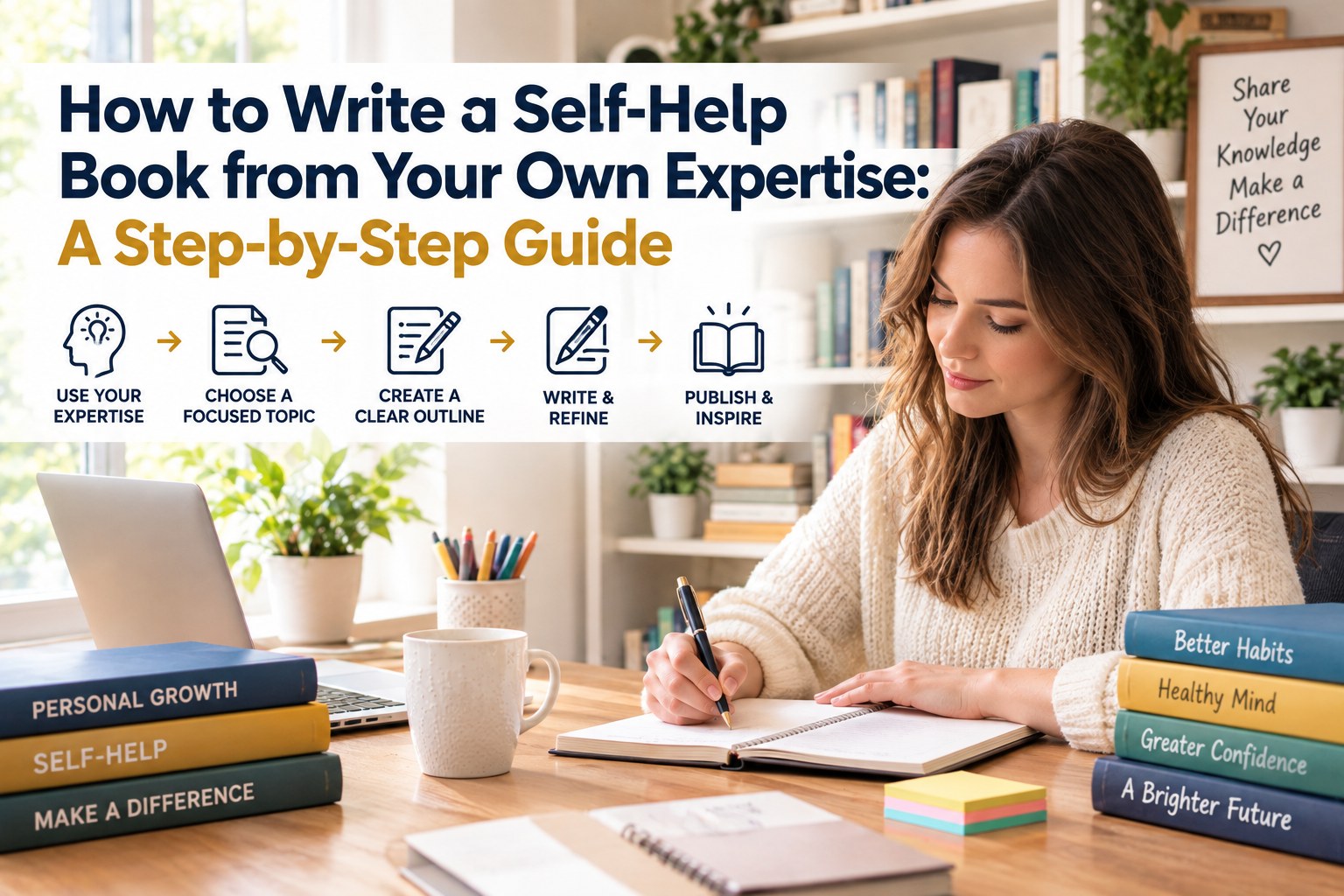
To write a self-help book from your expertise, pick one problem you can truly solve, turn what you know into a repeatable method, and outline the reader’s path from stuck to solved. Write in your own voice, add an exercise to every chapter, then edit with real readers and publish.
To write a self-help book from your expertise, pick one problem you can truly solve, turn that knowing
If you have spent years helping clients, students, patients or teams get results, you already hold most of what a good self-help book needs. The harder part is not knowing enough. It is knowing how to take everything in your head and shape it into something a stranger can read, trust and use on a Tuesday night with a cup of coffee.
This guide walks you through that process one step at a time. It is written for coaches, consultants, therapists, trainers, founders and professionals who want to share what they know without writing a textbook or a memoir by accident. You do not need fame or a perfect life story. You need a clear message, a method and a structure.
The Roadmap at a Glance
Here is the full path before we go step by step:
- Audit your expertise.
- Choose one problem and one promise.
- Get to know your reader.
- Turn what you know into a method.
- Build credibility without bragging.
- Outline and structure the book.
- Write in your voice and make every chapter actionable.
- Handle responsibility and risk.
- Edit and test with real readers.
- Choose a title and a publishing route.
- Build your platform and plan the launch.
- Decide whether to write it alone or hire help.
Why Your Expertise Is Your Biggest Advantage
Readers do not pick up a self-help book to admire the author. They pick it up because something in their life is not working and they want it fixed. Your experience gives you a head start, because you have seen the problem up close and you know what actually helps.
It also helps to understand what you are writing, because three kinds of books are easy to confuse:
- A reference book holds everything you know about a subject. It is useful, but readers rarely finish it or change because of it.
- A memoir is built around your own story. It can inspire, but the reader is a spectator.
- A self-help book is built around the reader’s change. It uses your knowledge, your stories and your personality as tools to move them forward.
The strongest self-help books combine four things: what you know, what you can do, what you have lived through, and the personality that makes you worth listening to. Readers get results when they practice a skill, not when they simply absorb information. Your job is to guide that practice.
If your expertise sits in a specific field such as business, health, education or relationships, our nonfiction book writing services cover the wider genre and show how experts turn knowledge into finished books.
Step 1: Audit Your Expertise
Before you outline anything, take stock of what you actually have. Most experts underestimate their own material because it feels ordinary to them. It is not ordinary to the person who has never seen it before.
Start with four lists:
- Problems people bring to you. What do clients, colleagues or friends ask you for help with again and again?
- Results you have produced. Which outcomes have you delivered for others, or for yourself, that you could describe clearly?
- Stories that taught you something. Think of mistakes, turning points and surprising wins that changed how you work.
- Questions you answer repeatedly. If you give the same explanation in every first meeting, that explanation may be a chapter.
Then separate what you know from what you can teach. You may know a hundred things about your field, but only a handful can be turned into steps a reader can follow. That shorter list is the real foundation of your book.
Try this quick exercise: write down the five questions clients ask you most, and next to each one, the answer you usually give. You may be looking at your first draft of a table of contents.
Step 2: Choose One Problem and One Promise
A self-help book fails most often when it tries to help everyone with everything. The books that work are specific. They are written for one reader, one problem and one outcome.
Compare these two ideas:
- Vague: a book about confidence, balance, mindset and productivity.
- Specific: a book that helps first-time managers stop overthinking feedback conversations.
The second one is easier to write, easier to explain and easier to sell. You can picture the reader and you know what a successful result looks like.
Write your core message as a single sentence: “This book helps [reader] do [outcome] by [method].” If you cannot finish that sentence, the idea is probably still too broad.
Next, try writing the back-cover copy before you write the book. Two short paragraphs are enough. Describe the reader’s problem, then the change they can expect. If you drift into side topics, cut them. They may belong in a second book.
Step 3: Get to Know Your Reader
You may feel you already know your audience because you work with them. That helps, but a book reader is different from a client. They cannot ask you a question, so everything has to be clear on the page.
Build a simple reader profile in one sentence: who they are, what they are struggling with right now, and what they want instead. “Busy professionals” is too general. “New managers who lose sleep over performance reviews” is closer.
Then do some research on the market:
- Read the reviews of books already in your niche. Notice what readers praise and what they complain about.
- Pay special attention to low ratings. They often reveal what readers wanted and did not get.
- Look at the language reviewers use to describe their problems, and use those words in your own writing.
- Decide what role your reader expects to play. Some want to learn, some want to practice, and some want to be coached.
This research is not about copying other books. It is about finding the gap where your experience can say something new.
Step 4: Turn What You Know into a Method
Here is where expertise becomes a book. A pile of good advice is helpful, but a method is memorable. A method gives the reader a path to follow and gives you a way to organize your chapters.
Look at how you work with people. Is there an order to what you do? Do you move clients through the same stages, ask the same sequence of questions, or use the same checklist? That pattern is your method, even if you have never given it a name.
Turn it into something repeatable:
- Break it into clear stages or principles.
- Give it a simple name or framework that is easy to remember.
- Make sure each stage has an action the reader can take.
- Test it by asking whether a stranger could follow it without you in the room.
Here is a quick example. Imagine a career coach who notices that nearly every client goes through the same four stages: getting clear on what they want, finding the real obstacle, testing a small change, and building a habit that sticks. Those four stages become four parts of a book, each with its own chapters, stories and exercises. The coach did not invent anything new. They simply noticed the pattern they already follow and gave it a shape a reader can use.
Watch out for the curse of knowledge. Experts often skip steps because the steps feel obvious. Slow down and explain what you now do automatically. Imagine you are teaching someone on their first day, and write down every move.
Step 5: Build Credibility Without Bragging
Readers want to know why they should trust you, especially when the subject affects their money, health, career or relationships. Credibility does not mean listing every award you have won. It means showing, honestly, why your advice is worth following.
A few ways to do that well:
- Say who you are and what you have done. A short author section near the start is enough. Keep it factual and relevant to the problem.
- Back your claims. Where your advice rests on research or a recognized framework, say so and cite it properly.
- Use real examples. Stories from clients or from your own life make advice believable, as long as you have permission and protect identities.
- Be honest about limits. Readers trust authors who explain what their method can and cannot do.
If you need help presenting your background in a clear and professional way, our author bio writing service can help you shape it for the book and for your listing.
Step 6: Outline and Structure the Book
A strong outline keeps you from the mid-book slump where good ideas turn into scattered notes. It also protects the reader’s experience, because a self-help book is really a guided journey.
First, choose a structure that fits your material:
- Step-by-step guide: each chapter builds on the last and walks the reader through a process.
- Problem and solution: each chapter takes on one common pain point and offers a fix.
- Narrative with lessons: your story carries the book, with takeaways woven in.
- Practice-based: the book is organized around daily or weekly exercises.
Then create a repeatable chapter template. Many successful books follow a rhythm like this: name the problem, explain the idea, tell a story, give the steps, offer an exercise, and close with a takeaway. A template makes drafting faster and gives readers a familiar pattern.
Map the reader’s journey from start to finish. Where do they begin? What should they feel and do at each stage? How will they know they have arrived? Plan an opening chapter that acknowledges their problem and states your promise, and consider a short “how to use this book” note.
Finally, decide on a target length and chapter count. Self-help books vary widely in size, and a focused short book often serves readers better than a long one that wanders. Aim for as long as it takes to deliver your promise and no longer.
Step 7: Write in Your Voice and Make Every Chapter Actionable
Now you write. The goal of the first draft is progress, not polish. Set a realistic daily goal, even a modest one, and stick to it. Consistency beats bursts of effort.
Choose a voice and keep it steady. Speaking directly to the reader as “you” works well for most self-help, because it creates a personal, teacher-and-student feel. Decide what role you play, whether that is coach, guide, teacher or fellow traveler, and let that shape your tone.
A few habits help the writing flow:
- Write the way you would explain it out loud. Dictation tools can help you capture a natural voice, especially if typing feels stiff.
- Follow your outline, and use placeholders when you get stuck so you can keep moving.
- Keep stories tied to the reader’s problem. If a story is mainly about you, ask what the reader learns from it.
- Keep your advice specific. Readers often complain that self-help is too vague, so say exactly what to do and when.
One more tip: keep a running “parking lot” document while you draft. Whenever a good idea shows up that does not fit the current chapter, drop it there and keep moving. Many authors find their next book, or a bonus chapter, hiding in that file.
Then make every chapter actionable. A reader should never finish a chapter wondering “now what?” End with something they can use:
- An exercise or reflection prompt
- A checklist or template
- A short case study to analyze
- A small action step to take that week
This is what separates a book people finish from a book people shelve. The reader changes by doing, so give them something to do.
Step 8: Handle Responsibility and Risk
When you give people advice, you carry some responsibility for it. A few simple precautions protect your readers and you.
- Add a disclaimer where it matters. If your book touches on health, mental health, legal or financial decisions, say clearly that it is general information and not a substitute for personal professional advice. For wording that fits your situation, speak with a qualified attorney.
- Get permission for client stories. Ask for written permission, and change names and identifying details so no one can be recognized.
- Credit your sources. Quote and cite research, books and other people’s ideas correctly.
- Avoid guaranteed results. Describe what your method can help with, but do not promise outcomes that depend on the reader’s circumstances.
These steps also build trust. Readers notice when an author is careful and honest.
Step 9: Edit and Test with Real Readers
A first draft is not a book. Give yourself time away from the manuscript, then come back and edit with fresh eyes.
Start with your own pass:
- Cut repetition and anything that does not serve your core message.
- Check that every chapter supports the promise and ends with a takeaway.
- Replace vague language with specific language.
- Read the manuscript aloud to catch awkward sentences.
Then bring in outside eyes. Share the draft with a few readers who match your target audience and give them specific questions: where were you confused, where did you lose interest, and which advice would you actually try? When several readers get stuck in the same place, fix it instead of defending it.
Finally, consider professional help. A developmental edit strengthens structure and clarity, and a copyedit catches errors and keeps the text consistent. Our book editing services cover each stage, and if you want a step-by-step process for your own passes, see our guide to the book editing checklist before you self-publish.
Step 10: Choose a Title, a Subtitle and a Publishing Route
Your title and subtitle do a lot of work. In self-help, clarity usually beats cleverness. The title should be memorable, and the subtitle should state the outcome so a stranger understands the book at a glance. Try a few options with beta readers or your audience before you commit.
Next, choose how to publish. Traditional publishing usually means writing a book proposal and often finding a literary agent. It can bring professional support and wider distribution, but you give up some control and the process takes time. Self-publishing is faster and gives you control over the design, pricing and timing, but you handle or hire for every task, from editing to formatting to marketing.
If you self-publish, a few practical points matter:
- ISBN. In the United States, Bowker is the official ISBN agency, and you can buy your own ISBN from Bowker. Owning your ISBN means you are listed as the publisher.
- Copyright. Your work is protected as soon as you create it, but you can also register your copyright with the U.S. Copyright Office, which creates a public record and matters if you ever need to enforce your rights.
- Platform. Many authors publish through Amazon KDP, sometimes alongside other retailers, to reach readers in print and ebook formats.
A professional cover and a clean interior also shape how readers judge your book. Our book cover designer team can help, and if you want guidance across the whole process, explore our self-publishing services and Amazon book publishing support.
Step 11: Build Your Platform and Plan the Launch
Marketing works best when it starts before the book is finished. People who already know and trust you are the easiest readers to reach.
- Start an email list early. Offer a free worksheet, a checklist or a sample chapter in exchange for an email address.
- Share your process. Post what you are learning and what you are writing, so readers feel part of the journey.
- Set up your home base. An author website with your bio, your book and a sign-up form gives readers a place to find you.
- Plan the launch. Ask early readers for honest reviews, prepare a bonus such as a workbook, and pitch yourself for podcasts and articles in your niche.
If you would like help with the website or the launch, see our author website design and book marketing services.
Should You Write It Yourself or Hire Help?
Many experts have the knowledge but not the time. If writing feels like a second full-time job, or you are not sure you can finish, it is worth considering help.
Writing it yourself gives you full control and a deep personal connection to the work. The trade-off is time and consistency, especially if you are busy running a practice or business.
Working with a ghostwriter is a common alternative for experts. A good ghostwriter interviews you, captures your ideas and voice, and drafts the book from your expertise. The ideas, stories and name on the cover stay yours. Many authors also use a hybrid approach, writing some chapters themselves and getting help with structure and drafting.
To learn how this works, explore our ghostwriting services and our ghostwriting process.
Common Mistakes to Avoid
- Choosing a topic that is too broad. One reader, one problem and one outcome is stronger.
- Writing about yourself instead of the reader. Use your story to serve their change.
- Skipping exercises. Without action steps, the book becomes information instead of help.
- Skipping research. Even a small amount of credible support strengthens your advice.
- Publishing without a real edit or a proof. Errors hurt trust, especially for an author who claims expertise.
Your Printable Master Checklist
Copy this list and tick items off as you go.
- Listed the problems I help people solve
- Wrote my core message in one sentence
- Described my reader in one sentence
- Wrote draft back-cover copy
- Named and defined my method
- Chose a book structure and chapter template
- Created a chapter-by-chapter outline
- Wrote an exercise or action step for every chapter
- Added disclaimers where needed
- Got permission for any client stories
- Edited the manuscript and tested it with beta readers
- Completed a professional edit and proofread
- Chose a title and subtitle
- Chose a publishing route and obtained an ISBN
- Planned my cover and interior design
- Started an email list and author website
- Planned my launch
Final Thoughts
You do not have to be famous to write a book that helps people. You need real expertise, a clear problem to solve and a method readers can follow. Start with the audit, narrow your focus, build a method, and give every chapter something to do. The rest becomes much easier once the structure is in place.
If you would like expert support at any stage, our team can help you from first outline to final files. Book a free consultation to talk through your idea.
Frequently Asked Questions
Can anyone write a self-help book?
Yes, if you have real knowledge people want and can explain it clearly. Expertise plus the ability to teach is what matters most. You do not need fame, though you do need honesty about what you know.
Do I need credentials to write a self-help book?
Credentials help readers trust you, but they are not the only route. Direct experience, documented results and honest limits also build credibility. If your topic affects health or finances, be clear about your background and add a disclaimer.
How do I start writing a self-help book?
Start with your expertise audit, then narrow to one reader, one problem and one outcome. Write your core message in one sentence and draft back-cover copy. Once that is clear, build your outline and chapter template.
How long does it take to write a self-help book?
It depends on your length, schedule and experience. Plan the stages: preparation, drafting, revision, editing and publishing. Set a realistic writing goal, add time for beta readers and edits, and leave a buffer for the unexpected.
How long should a self-help book be?
There is no single rule. Self-help books range from short guides to long volumes. Aim for the length needed to deliver your promise, with focused chapters, clear steps and nothing that pads the book.
What is the format of a self-help book?
Most open by naming the reader’s problem and your promise. The middle teaches your method in chapters that mix ideas, stories and exercises. The ending reinforces key takeaways and points the reader toward their next step.
Can I hire a ghostwriter to write my self-help book?
Yes. Many experts work with a ghostwriter who interviews them, captures their voice and drafts the book from their ideas. You remain the author, and you approve the content. It is a practical option for busy professionals.
How do I know if my self-help book is any good?
Test it with readers who match your audience, not only friends and family. Ask where they were confused, bored or inspired, and whether they would try the advice. Patterns in their answers show you what to fix.
