

Hiring a ghostwriter means handing your story, your expertise, or in some cases your life’s work to someone you have only spoken to a handful of times, and paying a significant sum for the privilege. If that makes you nervous, the nervousness is completely reasonable.
The stakes are real. A full book ghostwriting project can run anywhere from $2,000 to well over $15,000. Getting it wrong costs you money, several months of your time, and often the momentum to try again. Plenty of people have spent five figures on a manuscript that sounded nothing like them, arrived late, or never arrived at all.
Here is the encouraging part: finding a great ghostwriter is not about luck, industry connections, or knowing the right people. It is about knowing exactly what to evaluate before you sign anything. Most people simply do not know what to look for, which is why they only learn the warning signs after an expensive mistake.
This guide covers where to find ghostwriters, the seven specific things to check before you hire, what belongs in your contract, and the red flags that should end a conversation immediately. It also recommends platforms and approaches that are not our services, because the goal here is genuinely helping you hire well, not steering you somewhere.
If you are already familiar with the basics and want to see how a full-service approach works, our professional ghostwriting services cover the process end to end. Otherwise, let us start with what you are actually hiring for.
What Does a Ghostwriter Actually Do?
A ghostwriter is a professional writer who creates content that is officially credited to someone else. They remain anonymous, sign a confidentiality agreement, and transfer all rights to you when the project is complete.
But the job is considerably more involved than most people assume. A ghostwriter is not a typist who takes your notes and cleans them up. The process typically begins with discovery sessions to understand your goals and audience, followed by structured interviews that can run 10 to 30 hours for a full book. From there comes research, a detailed chapter outline you approve before drafting begins, the full manuscript draft, and two or three rounds of revision based on your feedback.
The most important thing to understand when hiring is that the interviewing and listening skills matter as much as the writing skill. A ghostwriter’s real job is extracting the stories, insights, and expertise that live in your head and giving them structure on the page. The English novelist Robert Harris made an observation worth remembering: a ghostwriter who has only a lay knowledge of your subject will keep asking the same questions a lay reader would ask, which actually widens your book’s potential readership considerably.
It is also worth stating plainly that ghostwriting is entirely legal and standard practice across publishing, business, politics, and entertainment. If you want a fuller picture of the role before you start evaluating candidates, our guide on what a ghostwriter is and how they work covers the fundamentals in depth.
Where to Hire a Ghostwriter: 6 Places to Look
There is no single best place to find a ghostwriter. The right source depends on your project size, budget, and how much of the vetting work you want to handle yourself.
Ghostwriting Agencies and Publishing Companies
Agencies offer a managed, full-service experience. They vet writers, match you with someone suited to your genre, and provide project management and accountability throughout. If something goes wrong, you have a single point of contact rather than a freelancer who has stopped answering emails.
This route typically costs $5,000 to $10,000 or more for book-length projects. Before committing, verify how they vet their writers, whether you get to meet and approve your specific writer before signing, and whether editing and publishing support are included in the fee or billed separately.
Curated Marketplaces
Curated marketplaces sit between agencies and open freelance platforms. Reedsy’s curated ghostwriter marketplace is the best known, and it vets writers for publishing credentials and experience before allowing them on the platform. You can filter by genre and specialty, which saves considerable time.
Rates typically run $0.10 to $0.30 or more per word. This route suits authors who want professional quality with more control than an agency provides, and more vetting than an open marketplace offers.
Freelance Platforms
Upwork and Fiverr host enormous pools of ghostwriters across every price point. The quality varies dramatically, which is both the appeal and the risk.
The single most useful piece of advice for these platforms: filter by writing samples and past work, not by star ratings. Ratings can be gamed and inflated. A portfolio cannot. Industry practice suggests engaging at least three to five candidates, checking their references, and conducting real interviews before choosing. These platforms work best for shorter content, blog posts, and eBooks rather than major book projects.
LinkedIn and Professional Networks
Many of the strongest ghostwriters work independently and never list themselves on a marketplace. LinkedIn search terms that surface them include “ghostwriter,” “book collaborator,” and “content strategist.”
This approach works particularly well for business books and thought leadership content, where familiarity with your industry genuinely matters to the quality of the finished manuscript.
Referrals from Published Authors
This is one of the highest-quality sources available and consistently the most underused. If you admire a book in your field, find out who helped write it. Authors are often far more open about ghostwriting collaborations than people expect, and a warm referral from someone whose book you respect is worth more than any number of five-star reviews.
Ask colleagues, mentors, and anyone in your professional circle who has published a book.
Direct Outreach to Authors You Admire
The best ghostwriters are frequently busy working rather than actively marketing themselves. Reaching out directly to writers whose work resonates with you can surface talent that never appears on a platform at all. Even if they are unavailable, experienced ghostwriters usually know others in the field and will happily make a referral.
If you would rather skip the search and work with a pre-vetted team, our ghostwriting team handles matching, project management, and quality control as part of the engagement.
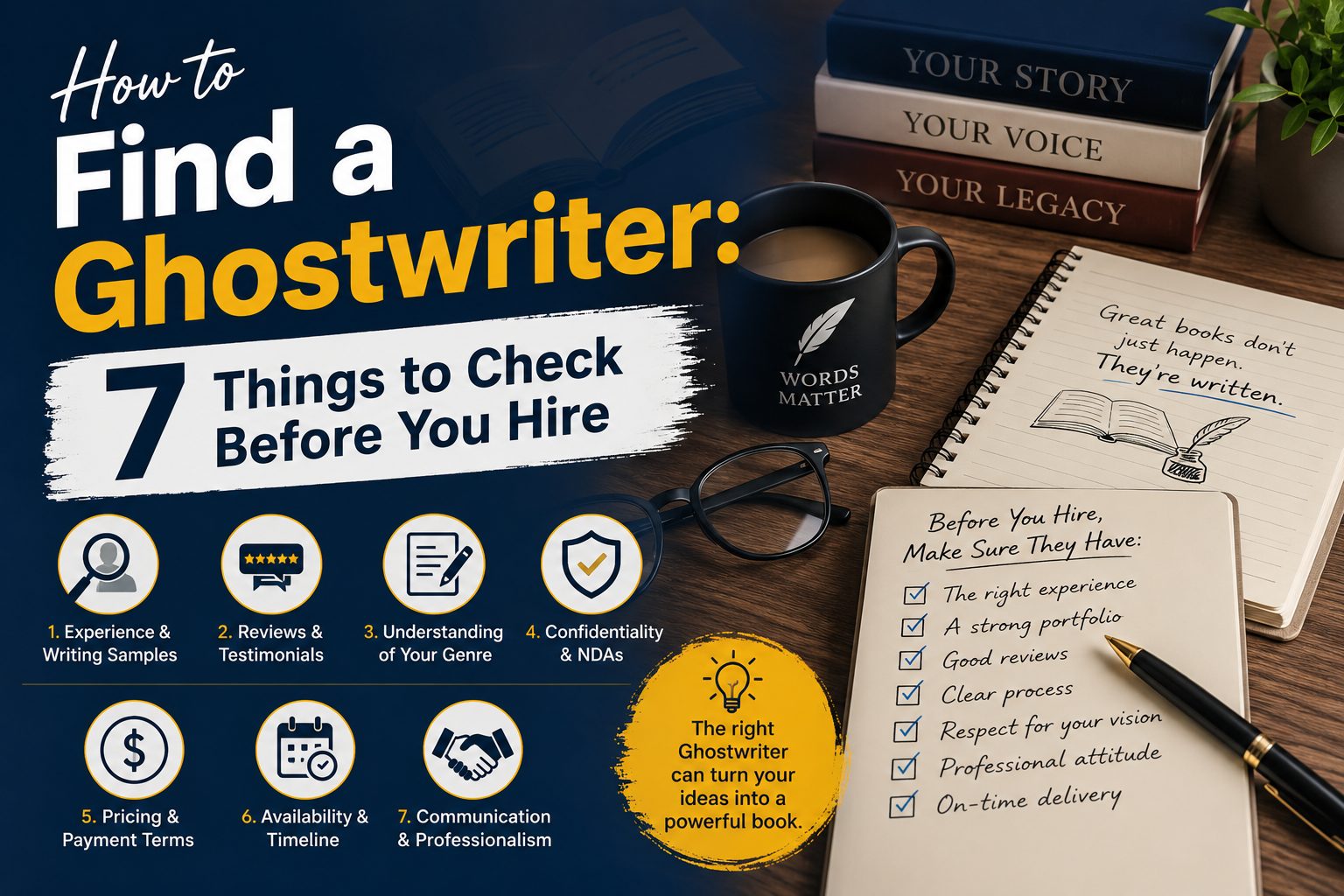
7 Things to Check Before You Hire a Ghostwriter
Once you have candidates, this is where the real work begins. Check every one of these before you sign anything.
1. Genre and Format Experience
A brilliant LinkedIn ghostwriter may be completely unable to structure a compelling 70,000-word book. A writer who has built a career on corporate leadership content may write beautifully and still miss the register entirely for a practical guide aimed at first-generation entrepreneurs, or a YA novel aimed at teenagers.
Vocabulary, tone, examples, pacing, and structure all shift meaningfully by genre and format. What to ask: “Show me two published projects in my specific genre.” Not adjacent genres. Not “similar” work. Yours.
The red flag to watch for is a portfolio that spans absolutely everything with no clear specialty. A generalist who claims equal expertise in fantasy novels, technical white papers, and children’s books is usually strongest at none of them.
2. Voice-Matching Ability
This is the single most important ghostwriting skill, and the hardest to fake. A good ghostwriter sounds like you. A great one essentially becomes you on the page, capturing your rhythm, your vocabulary, your humor, and your way of seeing things so completely that people who know you well cannot tell the difference.
When reviewing a portfolio, look specifically for samples that sound like genuinely different people. If every piece in their portfolio sounds the same, that is their voice showing through, not their clients’. Voice range is the thing to test for.
What to ask: “Walk me through how you capture a client’s voice.” A real answer involves extended interviews, reviewing your existing writing, studying how you speak in presentations or podcasts, and building a voice guide before drafting. A vague answer about “getting a feel for it” is not a process.
3. Verifiable Portfolio and References
Ghostwriters work under confidentiality agreements, so they often cannot name their clients. This is normal and expected. But a professional can still provide anonymized writing samples, references from clients who agreed to speak, or projects where credit was contractually permitted.
What to ask: “What can you show me, and who can I speak to?” Then actually follow up with the references. A ten-minute phone call with a past client will tell you more about someone’s communication style, reliability, and revision process than any portfolio ever will.
Professional affiliations are also a useful signal. Membership in organizations like the Association of Ghostwriters indicates a writer who treats ghostwriting as a career rather than a side gig. The disqualifying red flag is a complete inability to demonstrate any past work, in any form, to anyone.
4. A Clear, Documented Process
Professional ghostwriters have a defined process they can describe without hesitating: discovery, structured interviews, outline development and approval, chapter drafting with regular check-ins, revision rounds, and final delivery. Each stage has a timeline and a deliverable.
What to ask: “Walk me through your process from kickoff to final manuscript, with approximate timelines for each stage.” Listen for specificity. A real process includes milestones you approve before the project moves forward, which protects you from discovering at month five that the book is heading somewhere you never wanted.
The red flag here is vagueness. Answers about figuring it out as you go, or adapting to each client without any underlying structure, usually mean there is no process at all. Process is what protects your investment when the project inevitably hits a complication.
5. Interviewing and Listening Skills
Ghostwriting begins with listening, not writing. The ability to draw out stories you have never articulated, to notice the detail you glossed over that is actually the heart of the chapter, and to sit patiently while you find the right memory, is a distinct professional skill that has almost nothing to do with prose ability.
The best test is your very first call. A strong ghostwriter will arrive having already reviewed your LinkedIn profile, your existing content, and your positioning. They will come with observations, questions, and sometimes suggestions about angle or structure. They will ask far more questions about you than they spend describing themselves.
The red flag is a call with no preparation, where the writer knows nothing about you and spends most of the conversation pitching their services. If they will not invest an hour in preparation to win your business, consider what that predicts about the care they will bring to your book.
6. A Paid Sample or Trial Chapter
This is the most reliable way to evaluate voice fit before committing tens of thousands of dollars, and it costs a fraction of the full project.
Most professional ghostwriters offer a paid sample, typically one chapter or a few pages, developed after an initial interview. You get to see how they capture your voice on real material from your actual book, rather than guessing based on work they did for someone else in a different genre.
Paying for the sample matters. A free sample invites minimal effort and creates no obligation on either side. A paid sample gets their genuine best work and gives you a legitimate basis for comparison across candidates.
The red flag is refusing a paid trial entirely. That suggests either a lack of confidence in their ability to match your voice, or a lack of genuine interest in whether the fit is right, which are both reasons to keep looking.
7. Contract, NDA, and Payment Structure
This one is non-negotiable. No contract means no project, regardless of how well the conversations have gone or how much you like the person.
At minimum, your agreement must include a non-disclosure agreement, full intellectual property transfer to you upon final payment, a defined scope of work, a milestone-based payment schedule, and a clear revision policy. The next section covers the full contract checklist in detail.
On payments specifically, most professional ghostwriters use milestone structures, and the common breakdown is 25 to 30% on outline approval, 40 to 50% on first draft delivery, and the remaining balance on final manuscript approval. This protects both parties, because you are never far ahead of the work and they are never far behind on payment.
The red flag is anyone demanding 100% of the fee upfront. Legitimate professionals do not need it, and it removes every protection you have if the work does not materialize.
Ghostwriter vs. Co-Author: Which Do You Actually Need?
These two roles get confused constantly, and the distinction affects your credit, your rights, and your budget.
| Ghostwriter | Co-Author | |
|---|---|---|
| Credit | None, fully anonymous | Named on the cover |
| Contract | NDA plus full IP transfer | Collaborative agreement |
| Rights ownership | Client owns everything | Shared or negotiated |
| Compensation | Flat fee in most cases | Fee plus royalty share |
| Creative control | Client decides | Shared decision-making |
| Best for | Sole credit, full ownership | Genuine creative partnership |
There is also a middle option worth knowing about. The “as told to” credit places the writer’s name on the cover in smaller text beneath yours, as in The Autobiography of Malcolm X, as told to Alex Haley. Some ghostwriters are also credited in the acknowledgments as a contributor or researcher without receiving full co-author status.
The practical guidance is straightforward. If you want sole authorship and complete ownership of every right to the work, hire a ghostwriter. If you want a genuine creative partner who shares both the risk and the reward, and you are comfortable sharing credit, a co-author arrangement may serve you better. Whatever you choose, negotiate it explicitly at the start rather than leaving it to be worked out later.
What to Include in a Ghostwriting Contract
A good contract protects both parties and prevents the misunderstandings that derail otherwise promising projects. Here is what belongs in yours.
Non-disclosure agreement. The ghostwriter agrees not to identify themselves as the writer, discuss the contents of your project, or reference their involvement publicly without your written permission.
Full intellectual property transfer. All copyright and ownership transfers to you upon final payment. Confirm this is stated explicitly rather than implied, and that it covers all formats and territories.
Detailed scope of work. Target word count, approximate chapter count, the level of research included, the number of interview sessions, and specific deliverables. Ambiguity here is where most ghostwriting projects go wrong.
Milestone payment schedule. A standard structure runs 25 to 30% on outline approval, 40 to 50% on first draft delivery, and the remaining balance on final manuscript approval. Each payment should be tied to a deliverable you have reviewed.
Revision policy. How many rounds are included, usually two or three, what counts as a revision versus a full rewrite, and the cost of any additional rounds beyond what is included.
Timeline and deadlines. Specific dates for the outline, draft chapters, and final delivery, plus what happens if either party misses a deadline.
Editing inclusion. Clarify whether editing is part of the fee or billed separately. Ideally, all editing required to bring the manuscript to your satisfaction should be covered within the contract.
Termination clause. What happens if the working relationship does not succeed, including how partial work and partial payment are handled by both sides.
Confidentiality of your material. Protection for any sensitive personal, financial, or business information you share during the interview process.
For any project above roughly $8,000, have an attorney review the contract before signing. The cost of an hour of legal review is trivial relative to the project value, and it frequently catches terms you would not have thought to question.
Red Flags: When to Walk Away
Some warning signs justify ending a conversation immediately, no matter how promising everything else looks.
Full payment demanded upfront. Professional ghostwriters use milestone payments. Anyone requiring the entire fee before work begins has removed every protection you have.
No contract or NDA offered. A professional always provides a written agreement. Willingness to work on a handshake signals either inexperience or carelessness with your interests.
No verifiable portfolio. Confidentiality agreements limit what can be shown, but a complete inability to demonstrate any past work, provide any reference, or point to any published result is disqualifying.
Refusing a paid sample chapter. Most professionals welcome the chance to prove voice fit before you commit to a large project.
Unrealistically fast turnaround promises. A complete 60,000-word book in three weeks means either AI-generated output or a rushed draft that will need extensive rework. Quality ghostwriting takes months.
Quotes far below market rate. In the USA market, a full book quote under $1,000 typically signals AI-generated content, offshore outsourcing, or templated writing that will not sound like you.
No preparation before your first call. A ghostwriter who has not reviewed your content or positioning before speaking with you is unlikely to invest the care your book requires.
Pressure and urgency tactics. Limited-time discounts, pressure to sign immediately, or reluctance to let you compare options are sales techniques, not professional practice. As publishing industry expert Jane Friedman has documented extensively, urgency pressure is one of the most consistent markers of predatory author services.
How Much Should You Expect to Pay?
Ghostwriting fees vary enormously, and knowing the ranges helps you spot both overcharging and suspiciously cheap quotes.
- Blog posts and articles: $50 to $300 per piece
- Short eBooks: $500 to $2,000
- Full nonfiction book: $2,000 to $10,000 and above
- Memoir: $3,000 to $5,000
- Per word rates: $0.10 to $0.50 or more
- Per hour rates: $30 to $120
Pricing correlates strongly with experience, published credits, and specialization. Elite ghostwriters with verified bestseller credits routinely command six figures, and they have waitlists.
It helps to remember what the fee actually covers. You are not paying for typing. You are paying for structural expertise, professional interviewing skill, research capability, revision management, and a dramatically reduced risk of ending up with an unpublishable manuscript after a year of work. For a full breakdown of every pricing model and tier, see our complete guide to ghostwriter pricing.
Your Ghostwriter Vetting Checklist
Before you sign with anyone, confirm they can check every box on this list.
- Verified published work in your specific genre, not adjacent ones
- Portfolio samples that demonstrate genuine voice range across clients
- References or anonymized work you can actually review
- A documented, step-by-step process with clear timelines and milestones
- Preparation before your first call, showing they researched you
- Willingness to provide a paid sample chapter
- A written contract including NDA and full IP transfer
- Milestone-based payment schedule, never full payment upfront
- A defined revision policy with the number of rounds specified
- Editing included or clearly scoped and priced
- Transparent pricing with no urgency or pressure tactics
- A single point of accountability for the duration of the project
If a candidate misses one or two items, ask about them directly. Sometimes the answer is reasonable. If they miss several, keep looking. There are a lot of ghostwriters, and you only need one who is right.
If you would rather not vet candidates one by one, our ghostwriting team checks every box on this list. Every writer is vetted for genre experience and published credits, every project runs on a documented process with defined milestones, and every engagement includes a full contract with NDA, IP transfer, and a clear revision policy. You can see how our ghostwriting process works in detail, or get a free consultation to discuss your specific project.
Frequently Asked Questions
How do I find a good ghostwriter?
Start by defining your project clearly, including genre, target word count, timeline, and budget. Then search across ghostwriting agencies, curated marketplaces, freelance platforms, LinkedIn, and referrals from published authors in your field. Engage at least three to five candidates, review portfolio samples in your specific genre, check references, and request a paid sample chapter before committing to the full project.
Where is the best place to hire a ghostwriter?
It depends on your project. For full-length books where you want managed accountability, a ghostwriting agency or publishing company is usually strongest. For vetted independent professionals, Reedsy is a well-regarded curated marketplace. For shorter content and tighter budgets, Upwork and Fiverr offer wide range, though vetting takes more effort. Referrals from published authors consistently produce the highest-quality matches.
How much does it cost to hire a ghostwriter?
Ghostwriting costs range from $150 for a blog post to over $10,000 for a book by an elite ghostwriter. Most professional full-length nonfiction books cost $5,000 to $8,000 in the USA market. Per-word rates run from $0.10 to $0.50 or more, and hourly rates range from $35 to $120 depending on experience and specialization.
A ghostwriter works anonymously and receives no public credit, with all rights transferring to you upon final payment. A co-author is named on the cover, shares public recognition, and often shares royalties. Ghostwriters typically work for a flat fee under a non-disclosure agreement. Co-authors work as creative partners with negotiated credit and compensation.
Should I ask a ghostwriter for a sample chapter?
Yes, and most professionals offer this as a paid service. A sample chapter is the single most reliable way to evaluate voice fit before committing to a large project. A ghostwriter who refuses a paid sample is either lacking confidence in their ability to match your voice or not genuinely invested in whether the fit is right.
What should be in a ghostwriting contract?
At minimum: a non-disclosure agreement, full intellectual property transfer on final payment, a detailed scope of work with target word count, a milestone-based payment schedule, a defined revision policy, a project timeline with deadlines, clarity on whether editing is included, and a termination clause. For higher-value projects, have an attorney review it before you sign.
How long does it take a ghostwriter to write a book?
Most full-length ghostwritten books take three to twelve months, with the industry average running eight to twelve months for a complete manuscript. Well-scoped projects with an engaged and responsive client can complete in three to six months. Timeline depends on book length, research requirements, and how quickly you turn around feedback on drafts.
How do I know if a ghostwriter is legitimate?
Legitimate ghostwriters provide a written contract with an NDA, use milestone-based payments rather than demanding full payment upfront, can show verifiable work or references, have a documented process with clear timelines, and are willing to provide a paid sample chapter. They also prepare before your first call and ask more questions about you than they spend pitching themselves.
Do I keep the rights to my book if I hire a ghostwriter?
Yes, provided your contract states it explicitly. Standard ghostwriting agreements transfer all copyright and intellectual property to the client upon final payment, and the ghostwriter retains no claim to the work. Always confirm this is written into the contract in clear language rather than assumed from the nature of the arrangement.
Final Thoughts
Finding the right ghostwriter is not luck. It is a process of asking specific questions and refusing to skip the verification steps, even when the conversations feel warm and the timeline feels urgent.
The most important thing to remember is that fit matters more than credentials alone. A ghostwriter with an impressive client list who cannot capture your particular voice is the wrong ghostwriter for you, regardless of how good their portfolio looks. Someone else’s perfect collaborator may be a poor match for your book, and that is not a failure on anyone’s part. It is simply why the paid sample chapter exists.
Take your time. Use the checklist. Ask the uncomfortable questions about contracts and payment structures early, because a professional will answer them without hesitation and an amateur will not.
And if you would rather work with a team that already meets every standard on that list, our ghostwriting team checks every box, from vetted genre experience to full contract protection. Book a free consultation today and we will talk through your project, your timeline, and whether we are genuinely the right fit for your book.
